

Car Accident Lawyer for Baltimore’s Greektown
If you were seriously injured in a Greektown car accident, the immediate legal question is not simply whether an insurance claim was opened. It is what position the insurance company is taking on fault, injury, medical causation and value—and what evidence can be developed to challenge that position.
Greektown presents a distinctive claim environment because residential driving overlaps with industrial traffic and a significant heavy-truck presence. A collision can quickly become a dispute over lane position, turning radius, clearance, visibility, right of way, reaction time or whether the injured driver should have avoided the crash.
I have handled personal injury litigation in Baltimore for more than three decades. My approach is to identify the insurance company’s position, determine what proof actually bears on that position, and build the factual, medical and legal response necessary to contest it through negotiation and, when warranted, litigation.
In Greektown, residential driving can overlap with industrial and heavy-truck traffic. If the insurer contends that an injured driver entered a truck’s path, failed to leave adequate clearance, changed lanes improperly or should have anticipated a wide turn, insurance resistance may begin as a very specific fault narrative.
My response is not generic. I identify the precise proposition the carrier is relying on, devise the offense against that proposition, and determine which evidence can test it—vehicle positions, turning paths, lane geometry, impact location, physical damage, commercial video, electronic information when available, witnesses and the surrounding sequence of events.
Call Eric T. Kirk: 410-591-2835What Matters First After a Serious Injury in Greektown?
The first task is to determine where the dispute actually is. Some cases begin with a direct liability denial. Others begin with a more limited position: the other driver was primarily responsible, but the injured person supposedly contributed; the collision occurred, but the impact supposedly could not have caused the claimed injury; treatment was received, but the insurer says too much treatment was provided; or liability is accepted while the value of the injury is sharply minimized.
Those are different problems. They require different evidence. A fault dispute involving a commercial truck may require detailed reconstruction of movement and clearance. A medical-causation dispute requires a coherent medical chronology. A valuation dispute may turn on lost income, future care, functional limitations and evidence of how the injury actually changed the person’s life.
“The insurance company’s position tells me what I need to test. In a Greektown collision involving a truck or industrial traffic, the response should not be generic. Identify the precise fault theory, reconstruct the movement, build the proof, and attack the premise the carrier is using to limit the claim.”
— Eric T. Kirk
Greektown Injury Claim — Short Answer and Decision Logic
Short Answer: A Greektown accident can become an insurance dispute when the carrier uses the interaction between residential traffic, industrial vehicles and heavy trucks to dispute fault, causation or claim value.
Primary Risk: In a liability dispute, the insurer may contend that the injured person entered another vehicle’s path, failed to yield, failed to leave sufficient clearance, failed to maintain a proper lookout or otherwise contributed to the collision.
Insurance Position: The carrier may separately attack the mechanism of injury, prior medical conditions, treatment, wage loss, permanency, future care or the overall value of the claim.
Soft Denial: An insurer does not have to deny the entire claim to resist payment. It may accept that a collision occurred while refusing to accept the claimed injuries or their full value.
Decision Logic: Identify exactly what the insurer says happened. Then determine what evidence would confirm, weaken or contradict that proposition.
Key Greektown Factors: Industrial traffic mixed with residential driving and heavy-truck presence.
Next Evaluation Step: Examine the movement of the vehicles, right-of-way issues, lane and turning paths, impact evidence, available video and witnesses, medical chronology, wage evidence and longer-term consequences of the injury.
Reduced Attorney Fee Program: Greektown
30% Pre-Suit | 35% After Filing
For qualifying personal injury matters, subject to the facts of the case and the written fee agreement.
Where Is Greektown in Baltimore?
Greektown is a compact southeast Baltimore neighborhood centered around Eastern Avenue and situated near Highlandtown, Bayview and Canton. Its residential streets exist close to commercial and industrial activity, creating a traffic environment in which passenger vehicles, pedestrians and larger commercial vehicles can occupy the same relatively compact area.
For an injury claim, the important point is not that the neighborhood itself “causes” accidents. Human conduct causes collisions. The local environment matters because it can affect what the drivers could see, how vehicles were positioned, what movements were occurring, what evidence may exist and what arguments an insurer may later make about fault.
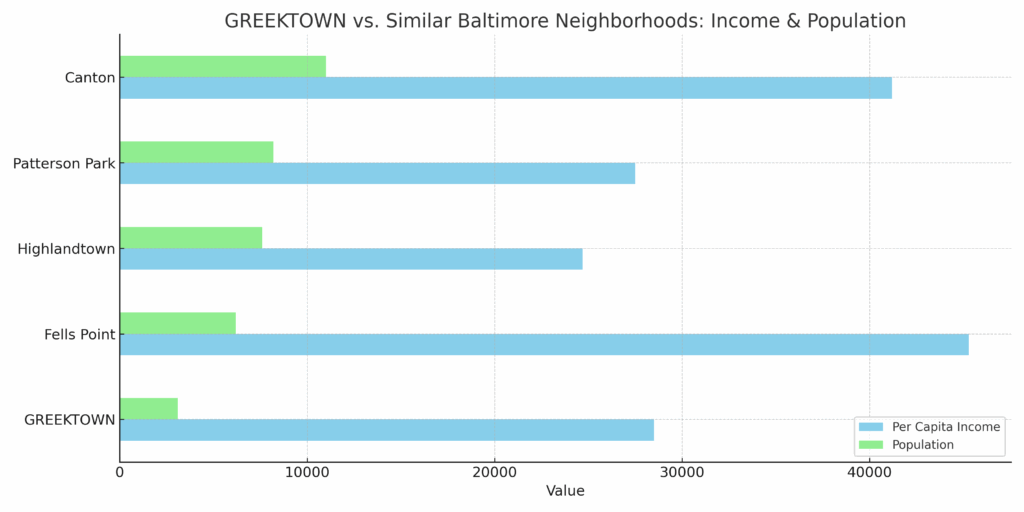
Local Factors That May Affect a Greektown Injury Claim
Two local conditions are particularly useful when analyzing how a Greektown collision may have occurred and how an insurance company may evaluate it.
| Greektown Factor | Why It May Matter to the Claim |
|---|---|
| Industrial traffic mixed with residential driving | The sequence may involve vehicles with different operating characteristics entering, leaving, turning through or sharing the same streets. Lane position, sightlines, movement and right-of-way can become disputed facts. |
| Heavy truck presence | Vehicle size, turning sweep, clearance, blind areas, braking, impact location and available commercial records may become important depending on how the collision occurred. |
Eastern Avenue and Greektown Injury Claims
Eastern Avenue is the principal roadway connection for this page because it carries traffic through Greektown and other southeast Baltimore communities. An accident there can involve ordinary commuter movement, commercial traffic, turning vehicles, pedestrians and vehicles moving between the main corridor and smaller neighborhood streets.
When an insurer builds a fault narrative around an Eastern Avenue collision, I want to know exactly what that narrative assumes: Which vehicle had which lane? Where did the turn begin? What could each driver see? Was another vehicle blocking a sightline? Where was the point of impact? What do the damage patterns show? Does video exist? Are the witness accounts consistent with the physical evidence?
The broader Baltimore roadway injury-claim guide explains why roadway context can matter to liability evidence without substituting road design for the conduct of the people involved.
Was a Commercial Truck Involved in the Greektown Collision?
That question changes the investigation.
In a passenger-car collision, the initial proof may center on vehicle positions, right of way, lane changes, turns, traffic controls, photographs, damage, video and witnesses. Those same subjects matter when a truck is involved, but additional questions may become important because a large commercial vehicle does not move through the roadway in the same way as a passenger car.
The Commercial-Truck Fork
If the carrier says you entered the truck’s path: I want the complete approach and turning sequence reconstructed.
If the carrier says you failed to leave room for a wide turn: I want to know the truck’s actual path, lane use, available space and where contact occurred.
If visibility is disputed: the driver’s field of view, relative vehicle positions and available video or electronic information may matter.
If the trucking company or another commercial entity is potentially involved: ownership, driver-employer relationships and relevant vehicle or company records may also require investigation.
These issues are addressed more broadly on my Baltimore truck accident lawyer page.
What Is the Insurance Company Actually Arguing?
A useful way to analyze a disputed claim is to stop treating “the insurance company won’t pay” as one problem. The carrier usually has one or more specific propositions that are driving its decision.
| Carrier Position | Practical Effect | Offense Against the Position | Proof to Examine |
|---|---|---|---|
| “You entered the truck’s path.” | Liability denial or contributory-negligence position. | Reconstruct who occupied which lane, when each vehicle moved and where the conflict developed. | Scene photographs, video, vehicle positions, damage, impact location and witnesses. |
| “You should have left more room for the truck to turn.” | Attempts to shift some or all fault to the injured driver. | Determine the actual turning sweep, lane usage, available clearance and relative vehicle positions. | Video, road/lane geometry, vehicle dimensions when relevant, damage patterns, testimony and available commercial records. |
| “The impact was too minor to cause these injuries.” | Medical-causation and valuation attack. | Separate assumptions about visible vehicle damage from the medical evidence of what happened to the person. | Medical chronology, examinations, diagnostic findings, treatment records and documented mechanism of injury. |
| “Your condition was already there.” | Attempts to disconnect the accident from some or all claimed harm. | Define the pre-accident baseline and identify evidence of a new injury or accident-related worsening. | Prior records, post-accident records, imaging, symptom chronology and appropriate medical opinion evidence. |
| “The treatment or claim is worth less than you say.” | Reduced voluntary settlement offer. | Document what care was required and what economic and functional consequences remain. | Records, bills, wage documentation, work restrictions, functional evidence and future-care evidence when supported. |
What If the Insurer Says You Contributed to the Greektown Accident?
That position has to be taken seriously in Maryland. An insurer may argue that an injured driver failed to yield, moved into another lane, entered a truck’s turning path, failed to keep a proper lookout or otherwise contributed to the collision.
But an adjuster’s assertion is not itself a finding of fact. The first task is to identify exactly what conduct is being attributed to the claimant and then determine whether the physical evidence, witness evidence and traffic sequence support that assertion.
My broader discussion of how contributory negligence can become an insurance-company defense to a Baltimore injury claim addresses this issue in greater detail.
What If the Dispute Moves From Fault to Medical Causation?
An insurance company can accept that its insured caused a collision and still dispute the injury claim. The carrier may contend that symptoms came from an earlier accident, degenerative changes, a prior condition, delayed treatment or some cause unrelated to the Greektown crash.
The injured person still has to prove accident-related harm. That makes chronology important: physical condition before the collision, mechanism of injury, onset of symptoms, medical evaluation, diagnostic findings, course of treatment and the person’s condition afterward.
A preexisting condition does not by itself answer whether a collision produced a new injury or materially worsened an existing condition. The factual and medical question is what changed because of the accident and whether the evidence can establish that change.
What If the Insurance Company Accepts the Claim but Offers Too Little?
That is still a dispute. A carrier can accept liability yet resist the amount requested for medical expenses, wage loss, pain, functional limitations, permanency or future consequences.
The adjuster can decide what the insurance company is willing to pay voluntarily. The adjuster does not decide the ultimate facts simply by assigning a number to the claim.
Valuation should therefore be built from proof rather than from the carrier’s starting number. The relevant evidence may include medical findings, treatment, work loss, future medical issues, daily limitations and the degree to which the injury has altered activities, employment or independence.
For the broader valuation framework, see what determines the strength and value of a Baltimore personal injury case.
Do Not Treat the Adjuster’s Position as the Law of Your Greektown Case
The danger is not that an adjuster’s opinion automatically becomes legally binding. It does not. The danger is that a repeated insurance-company premise can begin to control the entire negotiation if nobody identifies and tests it.
If the carrier repeatedly says you entered a truck’s lane, that remains a position to examine. If it says your injuries were preexisting, that remains a causation position to test against the medical evidence. If it says the case is worth a particular number, that remains the insurer’s voluntary valuation.
Do not negotiate as though an insurance-company premise has already been adjudicated. A repeated position is still a position. Repetition is not proof.
What Evidence Matters in a Greektown Injury Insurance Dispute?
The answer depends on the resistance being asserted. Evidence should have a job.
- Scene photographs: lane configuration, curb position, sightlines, signs, vehicle resting positions and surrounding conditions.
- Vehicle damage: point and direction of contact rather than merely the repair price.
- Video: business, residential, dashcam or other footage when it exists and can be obtained.
- Witnesses: observations of movement, signals, turns, speed, stopping and post-impact positions.
- Commercial-vehicle information: potentially relevant company, vehicle or electronic records when a truck is involved and the facts justify seeking them.
- Medical evidence: pre-accident baseline, symptoms, examinations, diagnostic testing, treatment progression and future issues.
- Economic proof: wage records, employment evidence, restrictions and documented financial consequences.
- Functional evidence: evidence of how the injury affected ordinary activities, work, family responsibilities or independence.
Evidence preservation matters because some proof can become harder to obtain with time. Video can be overwritten, witnesses become more difficult to locate, vehicles are repaired, and recollections become less precise. That is legitimate timing pressure—not an artificial deadline.
What Happens If the Greektown Insurance Dispute Does Not Resolve?
Negotiation is not the only forum in which a disputed injury claim can be evaluated. If a supported claim cannot be resolved because the insurer maintains a position that the evidence does not justify accepting, litigation may provide the mechanism for testing the dispute.
In an ordinary third-party car or truck accident case, the lawsuit is generally brought against the responsible person or other legally responsible party—not automatically against that party’s liability insurance company. The insurer may nevertheless fund the defense, retain defense counsel and exercise substantial control over settlement decisions.
Litigation changes the process. Disputed positions may then be tested through document production, sworn testimony, depositions, medical evidence, expert analysis when appropriate, motions, mediation and trial.
The question of who is actually sued after a Maryland car accident is distinct from the insurer’s role in defending and valuing the claim.
You can also review how the Maryland personal injury claim process moves from investigation through negotiation and, when necessary, litigation.
My Framework for a Disputed Greektown Injury Claim
Identify the position → devise the offense → build the proof → test the position → negotiate or litigate → pursue the supported value of the claim.
The insurance company understands how to evaluate and resist an injury claim. My role is to understand the particular resistance being used in your case and determine how the evidence can answer it.
Related Baltimore Injury and Insurance Dispute Guides
- Baltimore Injury Insurance Dispute Attorney
- Baltimore Car Accident Lawyer
- Baltimore Truck Accident Lawyer
- Maryland Personal Injury Claims
- Eastern Avenue Car Accident and Insurance Claim Issues
Nearby Neighborhoods
Greektown Car Accident and Injury Insurance Dispute FAQs
Why is the insurance company saying I caused my Greektown crash?
Short answer: The carrier may believe some aspect of your driving contributed to the collision.
In a Greektown claim involving industrial or truck traffic, that argument might concern lane position, right of way, clearance, a wide turn, visibility or whether the crash could have been avoided. The useful response is to identify the exact asserted act or omission and compare it with the physical and witness evidence.
What evidence matters most after a Greektown collision involving a truck?
Short answer: Evidence showing how the truck and the other vehicle actually moved.
Depending on the circumstances, useful evidence may include scene photographs, video, impact location, damage patterns, lane geometry, witnesses, vehicle positions and available commercial or electronic information. The evidence sought should correspond to the particular fault theory being asserted.
Can I still recover if the insurance company raises contributory negligence?
Short answer: An allegation of contributory negligence is not the same thing as a proven defense.
Whether recovery remains available depends on the facts, the evidence and the applicable law. Because contributory negligence can create serious consequences in a Maryland injury case, the specific conduct attributed to the injured person should be identified and tested rather than treated as established merely because an adjuster asserted it.
What if the insurance company says my injuries came from a prior condition?
Short answer: The claim becomes a medical-causation dispute.
The injured person must prove accident-related harm. That may require comparing the pre-accident medical condition with the post-accident condition and showing what changed. Prior records, current records, diagnostic findings, symptom chronology and medical opinion evidence may become important depending on the dispute.
What if the carrier accepts fault but says my Greektown injury claim is worth very little?
Short answer: Liability and value are separate issues.
An insurer may accept responsibility for the collision while disputing treatment, wage loss, permanency, future care, pain or functional limitations. The carrier’s offer reflects what it is presently willing to pay voluntarily. Claim value should be evaluated from the evidence rather than assumed from the offer alone.
Who decides what actually happened if I disagree with the insurance adjuster?
Short answer: The adjuster controls the insurer’s voluntary position, not the ultimate judicial determination of disputed facts.
If a viable claim cannot be resolved and litigation follows, disputed facts can be tested through the court process. Depending on the case and procedural posture, the ultimate decision-maker may be a judge or jury.
What happens if settlement negotiations fail?
Short answer: Litigation may become the next available mechanism for pursuing a supported claim.
A lawsuit can move contested issues into discovery, sworn testimony, document production, medical proof, expert analysis when appropriate, motions, mediation and potentially trial. Filing suit does not guarantee an outcome; it changes the forum in which the dispute is evaluated.
What are the risks of waiting to investigate a Greektown injury claim?
Short answer: Potential evidence can become harder to obtain.
Video may be overwritten, vehicles may be repaired, witnesses may become harder to locate and memories may become less precise. Medical and employment documentation also develops over time. Early analysis can therefore help determine what evidence should be identified and preserved without relying on artificial or invented deadlines.
Is the Insurance Company Fighting Your Greektown Injury Claim?
If a carrier is using fault, truck positioning, medical causation, treatment, prior conditions or value to resist a supported Greektown injury claim, I identify the position, determine what evidence can answer it, build the response and evaluate whether negotiation or litigation is the appropriate next step.
The insurance company can take a position. The question is whether that position can withstand the evidence.


