

ORANGEVILLE — Baltimore Personal Injury Lawyer (ZIP 21205)
TL;DR — ORANGEVILLE Injury Claims, Straight Talk
- ORANGEVILLE sits along major east-west corridors where insurers routinely dispute speed, visibility, and right-of-way
- Injury claims here often turn on medical timing, camera evidence, and contributory negligence arguments
- Delay — in treatment or documentation — is what carriers exploit first
- This page explains how injury claims actually get evaluated when an accident happens in ORANGEVILLE
ORANGEVILLE Roadways That Commonly Shape Injury Claims
Why Injury Claims in ORANGEVILLE Can BeTreated Differently by Insurers
ORANGEVILLE is not a quiet residential pocket. It’s a traffic-heavy East Baltimore neighborhood bordered by arterial roads, bus routes, and signal-controlled intersections that generate a predictable set of insurance defenses.
From an adjuster’s perspective, ORANGEVILLE claims invariably raise three immediate questions:
- Who controlled the intersection or lane at impact?
- Was the injured person promptly seen by a doctor, who objectively verified injury?
- Is there any argument — however thin — for contributory negligence?
That framing matters. Maryland law does not forgive even small “mistakes” by an injured person. Insurers know this and look for angles early.
- This page explains a frequent mistake that might affect how personal injury claims are evaluated after car accidents in Orangeville (Baltimore 21205).
- It highlights how injured people’s actions after a crash can sometimes be used by insurers to dispute injury severity.
- It clarifies why proper documentation and timely medical care matter for how claims are handled.
- It ties local traffic conditions and crash patterns in Orangeville to common insurer evaluation and defensive tactics.
- It outlines what adjusters look for without promising results or legal outcomes.
Baltimore Lawyer Discusses Frequent Mistakes After Car Accident: # 4 — Orangeville (Baltimore 21205)
In this video, a Baltimore personal injury lawyer explains the fourth common mistake people make after a car accident and why that mistake can influence how insurers evaluate injury claims for drivers and pedestrians in the Orangeville (Baltimore 21205) area.
Video Transcript: Baltimore Lawyer Discusses Frequent Mistakes After Car Accident: # 4 — Orangeville (Baltimore 21205)
Video Transcript — ORANGEVILLE (21205) Motor Vehicle Accidents
Eric T. Kirk, Baltimore Personal Injury Lawyer, explains routine steps to take after a motor vehicle accident in ORANGEVILLE, Baltimore City.
What to Do Immediately After a Motor Vehicle Accident in ORANGEVILLE
After being involved in a motor vehicle accident in ORANGEVILLE, Baltimore City, there are a number of routine steps that I advise my clients or prospective clients to take. First and foremost among those is to gather all of the important information from the other side.
Most of us these days have cell phones with camera ability, and it makes no sense not to take pictures of important insurance documents, identifying documents, the positions of the vehicles, and the conditions of those vehicles. Any other important document, person, or object that might play a role in the claim can simply be photographed and sent to the personal injury attorney of your choosing.
This transcript is provided for educational purposes only and discusses general considerations following a motor vehicle accident in ORANGEVILLE (21205). Each case depends on its own facts and circumstances.
ORANGEVILLE Accident Pattern & Traffic Summary (APTS)
ORANGEVILLE traffic patterns are generally shaped by:
- Multi-lane east-west corridors feeding into downtown
- Frequent bus stops and curbside activity
- Signalized intersections handling heavy volume
- Commercial cut-through traffic during peak hours
Insurers rarely argue what happened here. They argue how fast, who entered late, or whether the injured person reacted “too slowly.” Maryland law contains two insurance company friendly legal doctrines that mesh nicely with these questions: Contributory negligence and the boulevard rule
That’s why evidence timing can often matter more in ORANGEVILLE than narrative.
What Happens After an Accident in ORANGEVILLE (From the Insurer’s Viewpoint)
Here’s how carriers typically process ORANGEVILLE injury claims:
- They wait — to uncover alternative liability narratives
- They check EMS and ER notes for symptoms, findings, or gaps
- They look for surveillance from nearby businesses or MTA assets
- They assess fault aggressively, even in rear-end or T-bone crashes. Contributory negligence can be considered an extinction level event for these claims. If sustained, the claim is over.
Where medical care doesn’t line up cleanly with the incident, the defense narrative writes itself.
When Should You Seek Medical Care After an ORANGEVILLE Accident?
There is no 72-hour rule in Maryland. That’s a myth.
If you are hurt, go to the doctor. You can see a doctor whenever you choose. But insurers don’t care about myths — they care about arguments.
Delaying care gives the defense room to say:
- the injury wasn’t serious
- the pain came from something else
- symptoms were unrelated or exaggerated
From both a medical and legal standpoint, earlier documentation usually closes doors insurers want left open.
What to do after a car accident in ORANGEVILLE (21205)
This is process, not drama.
Should you move your car out of traffic?
If it’s a property-damage-only collision and the vehicle can be driven, Maryland’s “Move It” program says to move it safely out of the roadway and exchange information. If there are injuries or the scene isn’t safe, prioritize safety and emergency response.
What information actually matters?
- Driver + vehicle ID info (photos beat handwriting)
- Scene photos from multiple angles (signs, lane markings, signals, debris)
- Witness names/numbers (one neutral witness can change everything)
- A short note to yourself: what you felt physically in the first hour and first night
Common ORANGEVILLE Injury Scenarios (Illustrative Only)
The following examples are hypothetical and illustrative, not real cases:
- A driver proceeds on a stale yellow at a busy ORANGEVILLE intersection and gets struck by a turning vehicle; the insurer argues shared fault
- A pedestrian is clipped near a bus stop; the carrier argues inattentiveness, hedging to contributory negligence
- A rear-end collision occurs in stop-and-go traffic; the defense claims sudden stopping
In each scenario, fault is not assumed — it is constructed by the defense using timing, angles, and omissions.
How Contributory Negligence Is Raised in ORANGEVILLE Cases
Maryland’s contributory negligence rule is unforgiving. Insurers know that.
In ORANGEVILLE claims, adjusters commonly argue:
- failure to keep a proper lookout
- entering an intersection “late”
- walking outside a crosswalk — even minimally
These arguments don’t need to be strong. They just need to exist. Where strong they might defeat the case all together. Where the arguments are perhaps not as strong but still have some merit, they can operate to drive down case value.
What Evidence Disappears Fast in ORANGEVILLE
Time matters because evidence does not wait:
- Business surveillance overwrites quickly
- Dashcams may auto-delete
- Traffic cameras are not necessarily there, or, preserved automatically
- Witness memories fade fast in high-traffic areas
Waiting weeks or months makes reconstruction harder — and insurers know it.
ORANGEVILLE Insurance Law 101: What Actually Matters
ORANGEVILLE Insurance Law 101: Fault is evaluated under Maryland’s contributory negligence doctrine, not fairness, not degrees of fault, and not how serious the injuries are.
ORANGEVILLE Insurance Law 101: Medical records carry more weight than personal descriptions of pain.
ORANGEVILLE Insurance Law 101: Gaps in treatment are routinely used to challenge causation, and damages.
ORANGEVILLE Insurance Law 101: Ill conceived early statements to insurers often shape later defenses.
ORANGEVILLE Insurance Law 101: Claims are evaluated as litigation risks, and carrier exposure, not personal stories.
What an ORANGEVILLE Injury Lawyer Actually Does
This isn’t about slogans.
In ORANGEVILLE cases, legal work usually focuses on:
- locking down medical chronology and causation narratives
- where possible, neutralizing contributory negligence claims early
- obtaining video and third-party records
That’s process — not promises.
Roadways That Commonly Affect ORANGEVILLE Injury and Car Accident Claims
Many motor vehicle accidents affecting ORANGEVILLE residents occur on major Baltimore roadways that border, feed into, or carry traffic through the area. These corridors often shape how insurance companies evaluate fault, evidence, and claim value.
Frequently Asked Questions — ORANGEVILLE Injury Claims
Be careful. Ill conceived early statements are often used later to challenge consistency.
Orangeville Personal Injury Lawyer Tip #75: I generally suggest a hard and fast rule. You must talk to your own insurance company. You should let your personal injury attorney speak to the other party’s insurance company.
No. Every personal injury causing event is unique just as every person injury is. Value depends on injury, proof, economic loss, and risk — not ZIP code.
Delay doesn’t automatically bar a claim, but it gives insurers arguments that must be addressed carefully.
Orangeville Personal Injury Lawyer Tip #785: If you have sustained an injury you should get to prompt medical care whether at an emergency facility or otherwise. The reasons for delaying this evaluation are scant. The risks in delaying the evaluation are substantial.
Maryland law bars recovery if your negligence contributed to the injury. It is frequently raised by insurers looking to deny or limit your case. Whether that applies depends on evidence, not assumptions.
Not legally required in a typical Maryland automobile accident case. But reports often anchor timing, positions, and witness identities. Moreover if you find yourself making certain claims for uninsured motorist benefits or potentially claims against the state of Maryland you may find that you need a report or proof that you called the police.
Illustrative hypothetical ORANGEVILLE car-accident fact pattern
This scenario is illustrative only—not a real case and not a promise of outcome.
A driver leaves ORANGEVILLE and merges onto a Pulaski Highway feeder near the industrial edge of the neighborhood during weekday traffic. There’s a short gap to merge, a quick signal cycle, and vehicles compress into a stop-and-go line. A rear-end impact happens in that compression zone. The insurer doesn’t “deny liability” head-on—instead it delays while asking for more documentation, then claims the mechanics are unclear because:
- the nearest business camera overwrote footage before anyone requested it,
- the at-fault driver changes their story after speaking to an adjuster,
- and the injured person waited to treat, giving the defense room to argue “not related” or “not serious.”
That’s how ORANGEVILLE claims get undervalued: not by a single legal issue, but by evidence erosion + timeline arguments.
How to preserve video evidence after a rear-end crash near ORANGEVILLE’s Pulaski Highway feeders
- Write down the exact location immediately.
Use the nearest cross-street, address range, or obvious landmark. “Near Pulaski Highway” is not enough for later video requests. Most cell phones provide easy methods to get exact coordinates.
- Photograph the camera sources before you leave.
This is a relatively new addition to our standard guidance. While it makes sense to obtain what has been recorded by other cameras, it also makes sense to record where those cameras are, Take wide shots showing which businesses, intersections, or buildings have visible cameras pointed toward the roadway.
- Ask for preservation, not “a copy.”
It makes the most sense here to request both. When you contact a business, ask them to preserve the relevant time window first. Many places won’t export footage on the spot, and some systems overwrite quickly.
- Preserve your own data.
Save dashcam clips, phone photos, and any vehicle-app event logs (some cars store crash/impact events). Don’t edit the originals—make duplicates.
- Build a simple timeline.
Create a single note with: crash time, when symptoms started, when you sought care, and when you notified insurance. Insurance disputes thrive on timeline gaps. Keep in mind as you’re making your contemporaneous entries that ultimately if your car accident case ends up in litigation this could be discoverable by the defense.
- Use Maryland “Move It” rules appropriately.
If it’s property damage only and the car can move, get out of the travel lane safely—reducing secondary-crash risk. Before you move document the location of the vehicle Sterling with photos and videos.
Neighborhoods Near ORANGEVILLE Where Injury Claims Commonly Overlap
Motor vehicle accidents and personal injury claims arising in ORANGEVILLE often involve nearby Baltimore neighborhoods with shared traffic patterns, road access, and insurance considerations.
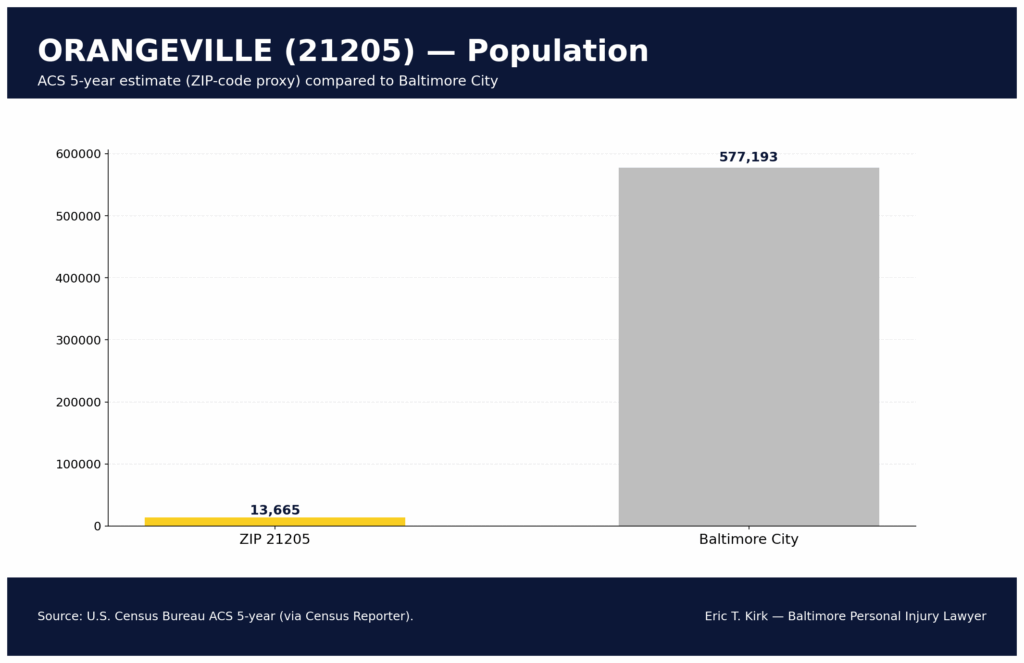
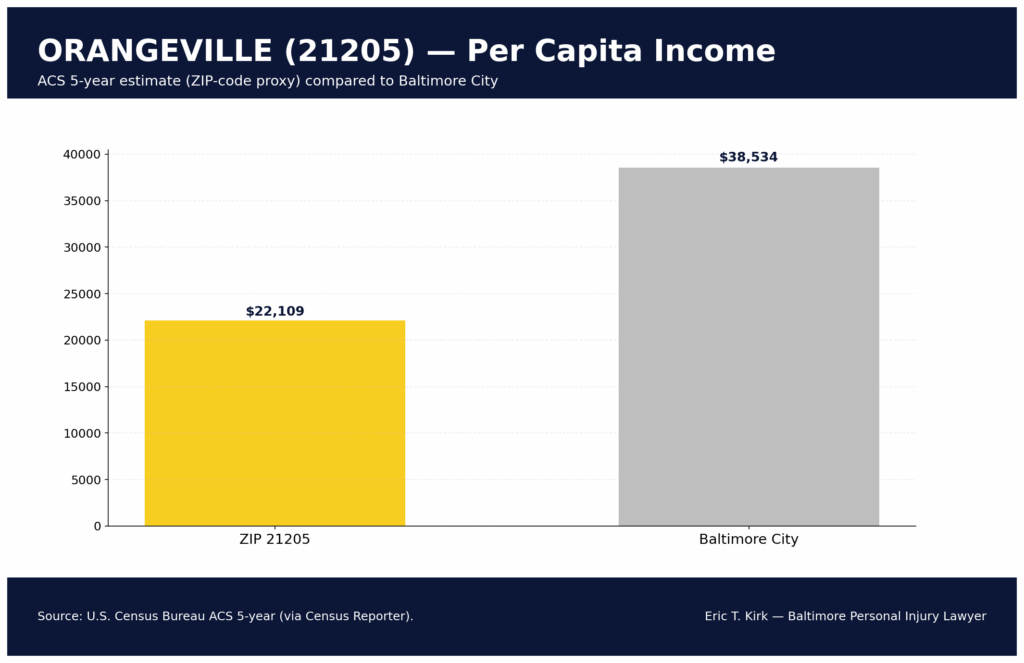
ORANGEVILLE (21205) demographics
Using ACS 5-year estimates via Census Reporter for ZIP 21205:
- Population (21205): 13,665
- Per-capita income (21205): $22,109
(Comparison point: Baltimore City population about 577,193 and per-capita income about $38,534 in the same ACS-via–Census Reporter tables.)
Related Baltimore legal explainers
Related Baltimore Personal Injury Resources:
- Baltimore Personal Injury Lawyer
- What Is My Case Worth?
- Insurance Claim Denial Lawyer
- Workers’ Compensation Lawyer
- Baltimore Work Injury Lawyer
Baltimore Roadway Claim Context
Additional Baltimore Neighborhood Claim Context
Key decisions that can affect your injury claim
How fault affects your case in Maryland
Dealing with the insurance company
Talk to a Baltimore Personal Injury Lawyer About an ORANGEVILLE Claim
If you were injured in ORANGEVILLE, the question isn’t whether the insurer will raise defenses — it’s which ones and how early.
Understanding how these claims are evaluated is the first step toward protecting your position.
- Baltimore Personal Injury Trial Lawyer
- Legal Analysis & Case Studies
- Baltimore Insurance Claims Denial Lawyer

For over three decades, I have battled against the nation’s largest insurance companies, always endeavoring to ensure my clients receive the compensation they deserve. As lead counsel in thousands of cases across Maryland, New York, and Florida, I have recovered millions for clients whose claims were wrongfully denied and delayed. Whether denying fair compensation for a personal injury victim or denying benefits to a homeowner, Insurance companies employ policy exclusions, technicalities, and lowball offers to deny and defeat claims. They also hire very good lawyers to fight you in court. So should you. When an insurance company unfairly rejects a claim, I stop them.

