TL;DR — Harbor East Injury Claims
- Harbor East injury claims often turn into disputes about timing, documentation, and “what the video shows.”
- Dense traffic patterns near the waterfront, hotels, and garages create recurring insurer defenses about lane position, stopping, and lookout.
- Evidence disappears fast: garage cameras, retail cameras, rideshare logs, and delivery tracking can be lost or overwritten.
- If you delay care, adjusters use that gap to argue “it wasn’t serious” or “it’s unrelated.”
- Eric T. Kirk has spent more than 30 years litigating injury cases against carriers who delay, deny, and minimize.
Where Harbor East Fits in Baltimore’s Injury Landscape
Harbor East sits on the east edge of Baltimore’s downtown waterfront, feeding constant movement between hotels, restaurants, parking garages, offices, and the Inner Harbor corridor. In real life, that means frequent stops, merges, curb activity, and pedestrian crossings that give insurers room to argue “shared fault” even when the collision looks simple on paper.
When the defense wants leverage, it usually does not start by admitting anything. It starts by controlling the narrative: what happened, when it happened, what evidence exists, and whether your medical documentation lines up with the claim. An experienced claims adjuster may look for a hole an inconsistency or something less than a direct match, and then attempt to exploit that narrative for the remainder of the case
Harbor East Accident Pattern & Traffic Summary
Harbor East claims tend to cluster, perhaps not all together unsurprisingly, round a few predictable conditions: stop-and-go congestion near waterfront destinations, short blocks with quick decisions, garages and loading activity, and pedestrians moving in groups. None of this “causes” accidents. The accidents happen because people make bad or quick or rushed driving decisions in a tight environment—speeding up to beat a light, drifting during a merge, turning without checking, or rolling through a crosswalk.
The insurer response is also predictable. Adjusters treat Harbor East as a “complex environment,” then use that label to dispute fault, question injury causation, and delay if there are gaps to exploit. “Continuing to investigate” is the bane of any personal injury settlement
Harbor East Contributory Negligence — What Insurance Companies Argue After a Crash
Under Maryland law, contributory negligence is one of the most powerful defenses insurance companies use to deny Harbor East injury claims. If an injured person is found to have contributed to an accident in any way, even slightly, recovery may be barred entirely — even if the other driver was overwhelmingly at fault.
Negligence means doing something a reasonably careful person would not do under similar circumstances, or failing to do something a reasonably careful person would have done. In Harbor East cases, insurers routinely frame everyday conduct as negligence: stopping patterns near parking garages, pedestrian movement near waterfront destinations, lane positioning on short blocks, or hesitation during merges.
Because Harbor East is a dense, mixed-use area with garages, valet zones, crosswalks, and heavy foot traffic, adjusters frequently argue that the injured person failed to maintain a proper lookout, moved unexpectedly, or could have avoided the impact. These arguments are often raised even when fault appears obvious.
Maryland’s contributory negligence doctrine is harsh and unforgiving. That is why insurance companies lean on it so heavily. A full explanation of how this doctrine works — and how carriers weaponize it — is explained here: Maryland contributory negligence law .
In car accident cases specifically, insurers attempt to convert normal Harbor East traffic behavior into a fault defense. Sudden stops, tight turns, curb activity, and pedestrian presence are all reframed as “shared responsibility.” How this defense is used in vehicle cases is explained here: contributory negligence in Baltimore car accidents .
Insurance companies also blur the line between contributory negligence and assumption of the risk. They may argue that an injured person knowingly exposed themselves to danger by crossing where they did or navigating congested traffic. While these doctrines are distinct under Maryland law, insurers often merge them to deny claims. The difference is explained here: assumption of the risk under Maryland law .
Special rules apply to children. Minors are not held to the same standard of care as adults; instead, their conduct is judged against what a reasonably careful child of similar age, intelligence, and experience would have done. Despite this, insurers still attempt to raise contributory negligence defenses whenever possible.
In Harbor East injury cases, contributory negligence is rarely an afterthought. It is often the central battlefield, shaped by early evidence control, video availability, and how the story is framed from the start.
Three Harbor East Local Factors That Matter in Injury Claims
| Local Factor | Why It Matters to the Insurance Company |
|---|---|
| Garages, valet zones, curb activity | They argue “unexpected stops” or “improper lane position” to push contributory negligence defenses. |
| High pedestrian volume near destinations | They challenge right-of-way facts, visibility, and whether the injured person “should have avoided” the impact. |
| Video evidence everywhere (but not forever) | They delay and then claim “no proof” once footage is overwritten or unavailable. |
Illustrative Harbor East Crash Scenario (Educational Only)
This example is illustrative only and not a real case.
A driver exits a parking garage toward the waterfront while a person runs across a short block. There is contact and property damage, but the real fight is the insurer’s process: the defense asks whether the injured person “darted,” whether the act was “reasonable,” whether a crosswalk was involved, and whether the claimant’s version matches any available video. If you hear these phrases, it’s reasonable to assume the insurer is investigating, and, on these facts, will likely raise a contributory negligence defense.
Baltimore Lawyer Discusses Frequent Mistakes After Car Accident In Harbor East
If you’ve sustained an injury in a Baltimore motor vehicle accident, including crashes occurring in or around Harbor East, there is little that can stand in the way of your recovery more than making a mistake that impacts the value of your case or the amount of money you are ultimately able to receive. An individual who is injured by an act of negligence, such as a motor vehicle accident caused by someone else and through no fault of their own, may assume that the other side should take care of everything, but this is not always the case. In every insurance policy, including the insurance policy of the injured person, there is a duty to cooperate with one’s own insurance company. Your own insurance company plays a key role in many motor vehicle accident cases, both by providing PIP or personal injury protection benefits and, depending on the insured status of the other side, potentially uninsured or underinsured motorist benefits as well. Those benefits are administered by your own insurance company, and it is vital that you cooperate with them fully at each stage of the procedure.
When Should You See a Doctor After a Harbor East Car Accident?
There is no magic “72-hour rule,” but here is the reality: if you wait, carriers argue your injuries were not serious or were caused by something else. Prompt care is not about panic—it is about creating clean medical documentation, linking symptoms to the collision, and preventing the defense from exploiting gaps. From both a medical and claims standpoint, getting evaluated sooner usually removes arguments the insurer wants to use later.
What Insurance Companies Focus On After a Harbor East Injury
- Whether there is video (and whether they can wait until it’s gone)
- Whether you made a statement that can be framed as “uncertainty”
- Whether treatment started late or looks “inconsistent” in the record
- Whether they can argue any contributory negligence (lookout, stopping, crossing location, lane position)
- Whether they can minimize the crash as “low speed” to devalue injuries
Harbor East Local Data (ZIP Proxy: 21202)
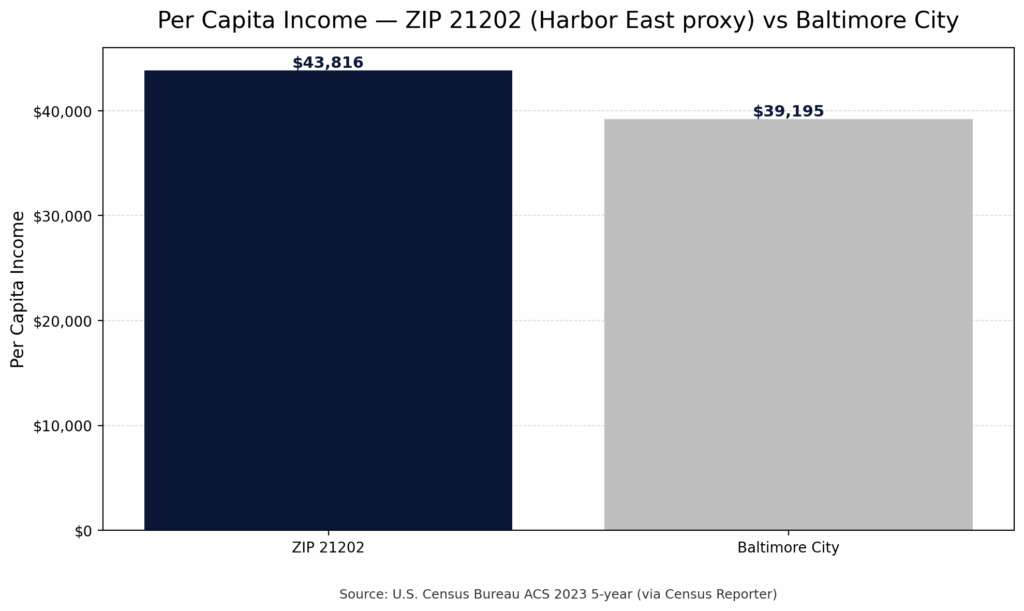
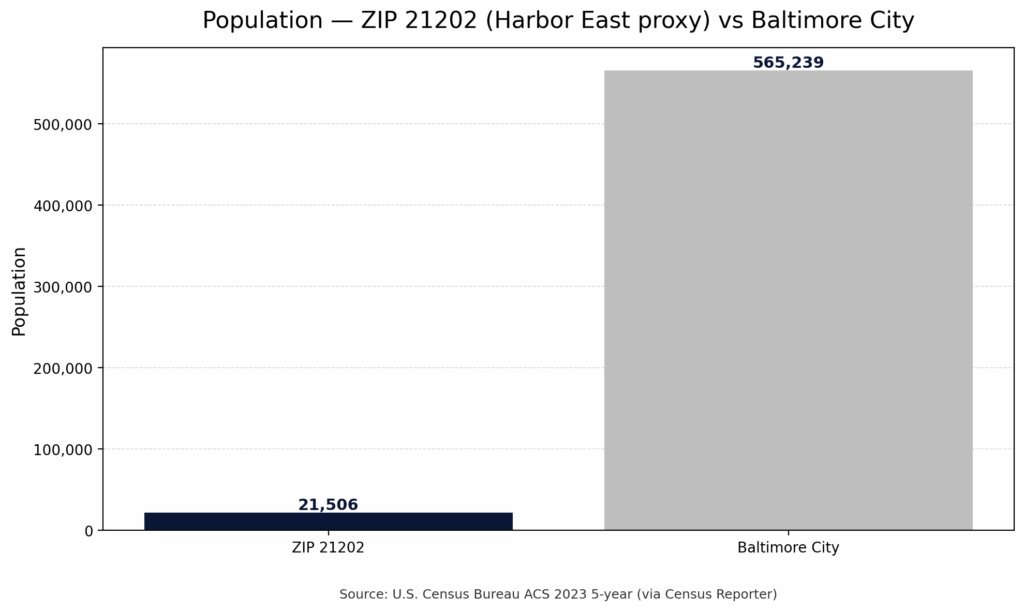
For Harbor East content, ZIP 21202 is a reasonable proxy for localized demographic signals. ACS 2023 5-year estimates for ZIP 21202 report: population 21,506; per capita income $43,816; median household income $61,578; poverty rate 24.1%; median age 33.6; and median home value $307,700.
Neighborhood Connections
Harbor East sits next to several neighborhoods where crash patterns overlap (short blocks, congestion, pedestrians, curb activity). If you’re comparing claim dynamics, start here:
Roadway Connections
Harbor East traffic feeds into Baltimore’s major downtown corridors. If your collision involved congestion, merges, signals, or curb activity, these roadway pages help explain how insurers evaluate those facts:
Talk to a Harbor East Personal Injury Lawyer
If you were injured in Harbor East, the carrier is already looking for a way to reduce responsibility, dispute causation, or frame contributory negligence. A careful review of evidence, records, and the insurance file is how you find the pressure points and stop the usual delay-and-deny tactics.
Harbor East FAQs
Not always, but the insurer will use the lack of a report to dispute what happened. If there’s no report, documentation matters more: photos, witnesses, property damage patterns, and any available video.
Harbor East Personal Injury Lawyers Tip #16: For most Harbor East personal injury cases- a police report is not “required”. For certain types of uninsured motorist claims or claims against the state of Maryland it might be. The absence of a police report is always a “failure to document” tactic that the insurance company is going to raise in denying or diminishing the value of your personal injury case.
Delay creates leverage. In dense areas like Harbor East, adjusters often wait while “an investigation” is ongoing, or they “are trying to reach their insured. In this gap, surveillance footage is overwritten and witnesses become harder to locate, then argue “insufficient proof” or “unclear fault.”
Yes. Carriers frequently argue lookout, crossing location, crosswalks, signal phase, or “should have seen the car.” In Maryland, that defense is taken seriously. It will often spell the end of your case unless you do something about it early.
Harbor East Personal Injury Lawyers Tip #811. Insurance companies are well aware that the finding of contributory negligence, even in a horrific accident where a plaintiff is maimed and the defendant is clearly overwhelmingly at fault, means there is no financial recovery for the plaintiff, which in turn means it’s a file that doesn’t cost the insurance company anything. They like those.
Of course all evidence is vital. Currently, Video is often the “biggest” piece—garage cameras, nearby retail cameras, and dashcams. Photos showing lane layout, signage, curb positions, and lighting also matter.
You are not required to help the opposing insurer build its defense. Recorded statements are often used to lock you into details you can’t prove later, uncover prior accidents, and obtain admissions or other details viewed favorable by the insurance adjuster.
Harbor East Personal Injury Lawyers Tip #445. I generally don’t mind when my clients give a recorded statement- together with me and the claims adjuster- as it can often lead to a quicker resolution of the case. The statement under oath is also a potential trap for the unwary plaintiff. A Savvy claims adjuster will pry the factual events of the auto accident, searching for signs that could lead to a contributory negligence denial.
Yes. Low-speed impacts can still cause neck, back, shoulder, and head injuries. The carrier may still minimize it as “no big deal,” so medical documentation matters.
Harbor East Personal Injury Lawyers Tip #1. It might be the most often employed tactic in the insurance company’s playbook. Routine, run of the mill , garden variety, every day accidents lend themselves well to the “this wasn’t that serious narrative” because they are, well…..routine. The strategy is often more subtle and is employed even in serious cases. You may hear phrases like it “could have been worse”, “no one was admitted to the hospital”, “thank God everybody survived”.
Coverage can become layered: the driver’s personal policy, the rideshare company coverage, and other involved drivers. Insurers often dispute which policy applies and when.
Harbor East How-To
How do I protect my Harbor East car accident claim
- Document the scene immediately.
Insurance companies love to point to gaps, holes, or perceived failures of evidence. It’s an unfair game because an insurance adjuster can simply point to something that you don’t have or can’t get and say that it was” a failure to properly document the claim”. Take photos/video of vehicles, lanes, signals, curb activity, lighting, and nearby cameras.
- Identify camera sources.
Note garage entrances, storefronts, hotels, and intersections that may have surveillance. I often like to advise my clients to “take pictures of the picture takers”. After an accident in Harbor East it can become important to record the location of the surveillance devices for later use.
- Collect witnesses early.
Get names and numbers—people disperse fast in Harbor East. Pictures of the individual driver’s license and other contact information can help.
- Preserve device evidence.
Save dashcam files, rideshare trip details, and phone photos in more than one place.
- Get medical evaluation when symptoms appear.
Well documented and contemporaneous treatment creates documentation insurers can’t hand-wave away later.
- Be cautious with statements.
Don’t guess or fill gaps—carriers use uncertainty to argue “inconsistent story.”
- Act early to preserve video surveillance.
It’s a common in recurring theme in these how-to guides. I’m not aware of any industry guidance on how long a private entity should keep video surveillance prior to recording over it as a matter of policy. Various government agencies point to time frames from 30 to 90 days.
Government records retention policies vary significantly by jurisdiction and medium. In New Jersey the State Records Committee established a thirty-day minimum retention limit for video recordings of public meetings. Conversely, the Washington Secretary of State
mandates that law enforcement radio transmissions and dispatch recordings be maintained for ninety days. More formal documentation, such as citations or specific law enforcement records identified by MRSC, often requires a three-year retention period or until the completion of a state audit. Generally, most states, including Texas and Florida, require body-worn camera footage to be held for a minimum of 90 days, though this increases significantly for footage involving use of force or criminal investigations. These varying timeframes highlight the balance between administrative transparency and data storage limitations.

Client Review
"Eric Kirk was a great attorney to me. He settled my personal injury case in about 5 short months, and handled my complicated situation with professionalism and a great attitude. Eric handled everything with the insurance companies, and I didn’t have to lift a finger. I am so grateful for the work Eric put in, and it won us my case! I would recommend Eric’s firm to anyone in need of an awesome attorney. Thank you Eric!"
C. Delaney